
Folder defaults
Open a folder’s ... menu and choose Settings. The folder gets the same Headers, Auth, Script, and Tests tabs as the collection, and they apply to every request in the folder, subfolders included.
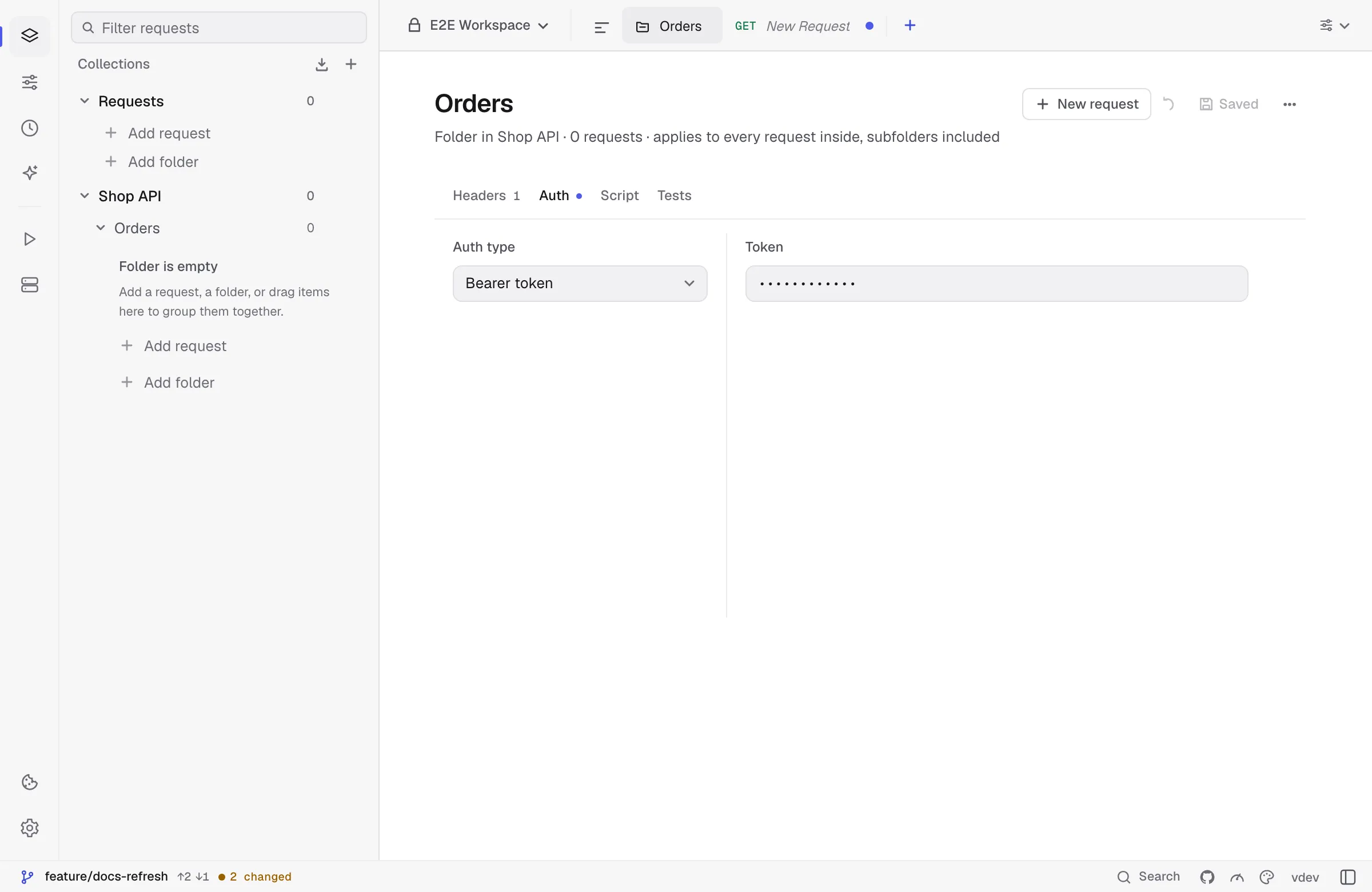
- Headers are layered collection → outer folder → inner folder → request, and the nearest one with the same key wins.
- Auth starts as Inherit from parent, which passes on whatever the parent folder or the collection sets. Choose a scheme to give the folder’s requests their own credentials, or No auth to send them without auth even when the collection has a token.
- Script and Tests run in the order listed under Scripts and tests.
Variables and transport settings stay at the collection level.
Renaming a folder keeps its settings; deleting it removes them along with its requests. A refreshed OAuth 2.0 token for an inherited auth is saved to the folder or collection that supplies it. Requests in the folder show what they inherit in their Settings tab. The CLI, the collection runner, load tests, and kurlo mcp apply folder defaults the same way the app does.
Saving and resetting
Section titled “Saving and resetting”In autosave mode, collection edits are saved after a short delay. In manual-save mode, click Save.
Reset defaults, in the ••• menu, clears collection headers, variables, auth, scripts, tests, and transport settings after confirmation. It does not delete requests or folders, and folder defaults stay. On a folder’s settings, the same menu item clears only that folder’s headers, auth, scripts, and tests.
Storage and export
Section titled “Storage and export”Collection defaults are saved with the collection:
- Local profile data is inside encrypted
requests.json. - Folder and Git workspaces store shareable defaults in YAML.
- Folder defaults are saved in
collection.ymlunderfolderDefaults. - Kurlo/OpenCollection export preserves supported collection and folder defaults.
Real secret values remain in Kurlo’s encrypted local profile when shared YAML uses {{kurloSecret:...}} placeholders. See Kurlo YAML format for the storage contract.