
Git-backed workspaces
Store Kurlo workspaces as YAML files, keep secrets local, and collaborate through Git.
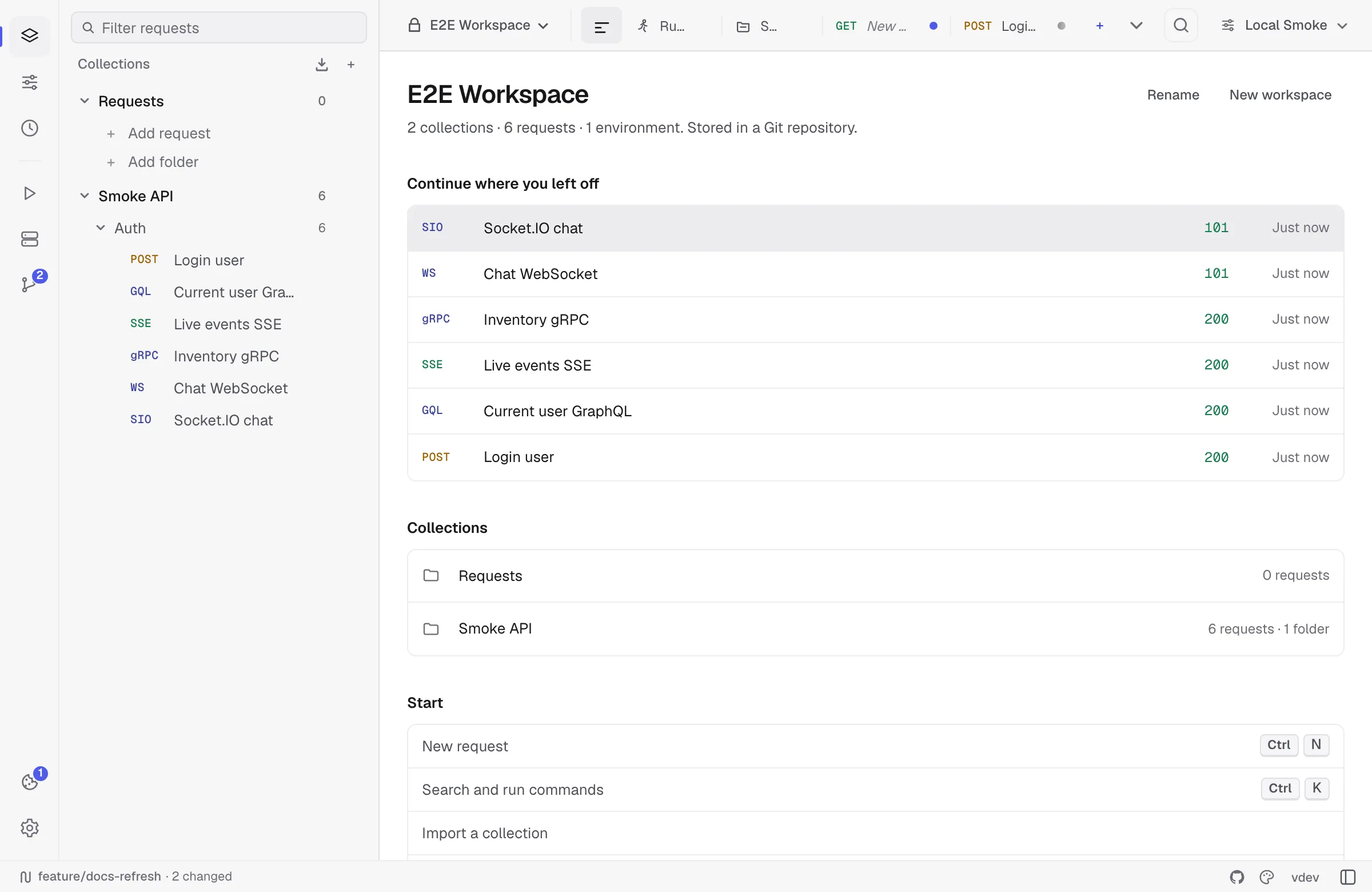
Kurlo can store workspace data in a folder instead of only inside the encrypted app profile. When that folder is a Git repository, the workspace becomes reviewable, branchable, and shareable with a team.
When to use Git storage
Use a Git-backed workspace when you want:
- API collections reviewed in pull requests.
- Stable YAML files instead of opaque JSON exports.
- Local-only secrets.
- Branches for API changes.
- Diff, conflict, commit, pull, and push workflows inside Kurlo.
Use the default app storage when the workspace is private, short-lived, or not meant to be shared.
Requirements
Kurlo runs the git command rather than bundling its own, so Git storage needs Git installed and on the PATH:
- Windows — install Git for Windows; Windows ships none.
- macOS — run
xcode-select --install./usr/bin/gitexists on a clean Mac but is only a stub until the Command Line Tools are installed. - Linux — install
gitfrom your distribution’s package manager.
Restart Kurlo after installing. Without Git, Kurlo says so on the Git screen and the folder still works as a local (non-Git) workspace — collections, environments, and requests all behave normally; only branches, commits, and remotes are unavailable.
What Kurlo writes
Shared files:
kurlo.yml.gitignoreworkspaces/**/*.ymlThe shared YAML contains workspaces, collections, explicit folder paths, requests, environments, defaults, scripts, and settings. Secret values are replaced with {{kurloSecret:...}} placeholders. Their real values stay in Kurlo’s encrypted local requests.json profile instead of the Git workspace.
See Kurlo YAML format for the public schema.
Starting a folder workspace
From the workspace overview or Git workspace screen:
- Choose a folder you control.
- Let Kurlo write the workspace YAML files.
- Optionally initialize Git in that folder.
- Add a remote when you are ready to share.
Kurlo only manages its own files. Other project files in the same repository are left alone.
Opening or cloning
You can open an existing folder workspace or clone a remote repository. After opening, Kurlo reads the YAML store, merges local secrets where available, and shows diagnostics for files it could not fully understand.
If the folder is missing or moved, Kurlo enters recovery mode and lets you choose another folder, open an existing repository, or clone again.
Daily Git flow
The Git workspace screen covers the common loop:
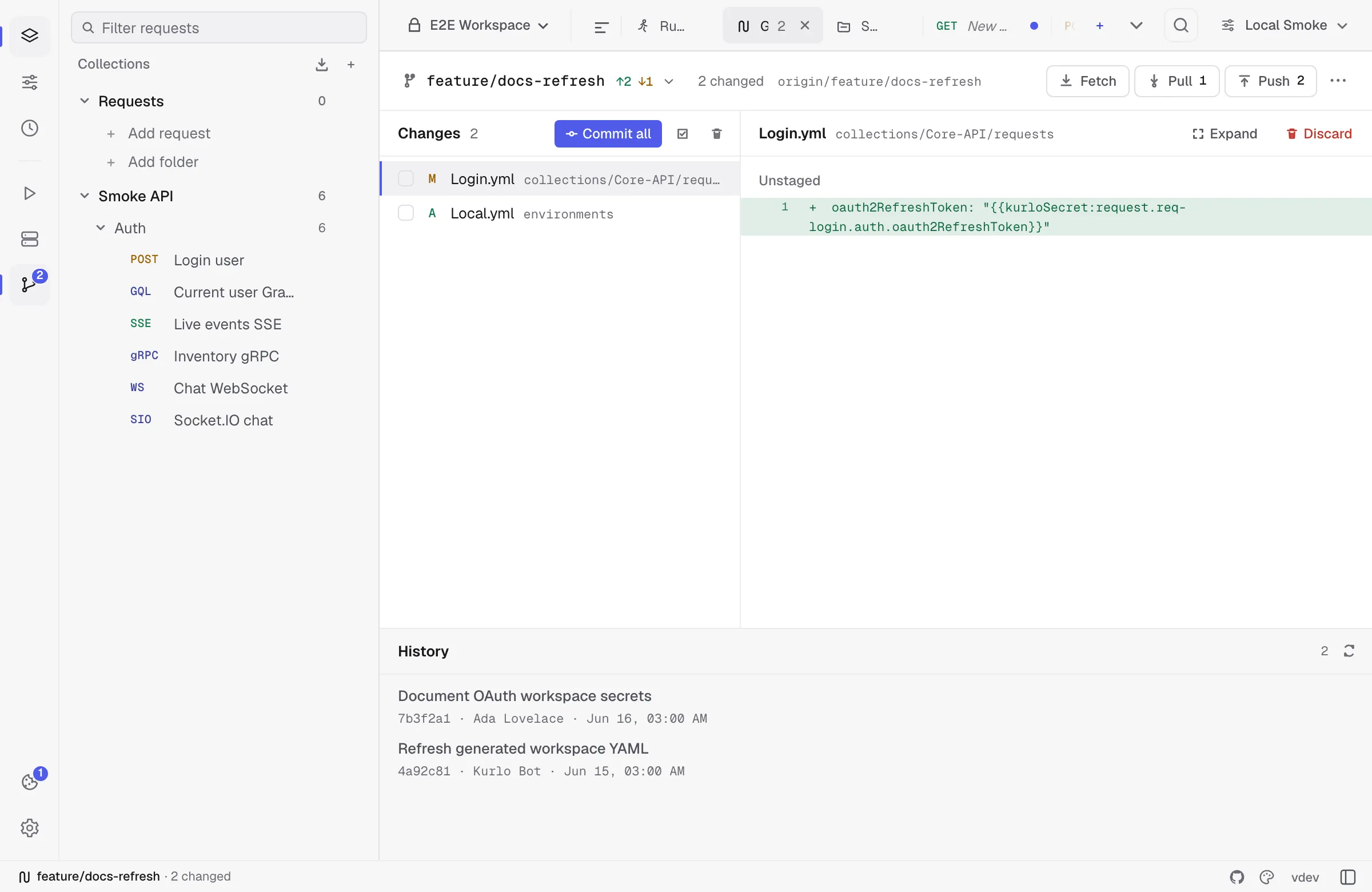
- Fetch to update remote refs.
- Pull using fast-forward, merge, or rebase strategy.
- Edit requests, environments, folders, and collection defaults in Kurlo.
- Review changed YAML files and diffs.
- Stage selected files or all Kurlo files.
- Commit with a message.
- Push to the configured upstream.
Kurlo shows ahead/behind counts, current branch, upstream status, remotes, stashes, changed files, commit history, and outgoing commits.
Branches and stashes
Branch tools include:
- Checkout local or remote branches.
- Create a branch from current HEAD or from a remote branch.
- Rename and delete branches.
- Pull a specific branch.
- Set tracking/upstream where needed.
Stash tools are available when local changes would block a pull or branch operation. You can stash, pop a stash, or let Kurlo offer an autostash-style flow before pulling.
Conflicts
When Git reports conflicts, Kurlo blocks normal workspace editing until the conflict is resolved. The conflict resolver can:
- Show ours/theirs versions.
- Parse inline conflict markers.
- Step through unresolved hunks.
- Accept ours, accept theirs, or edit the merged result.
- Continue or abort the Git operation.
This is intentionally conservative: Kurlo would rather pause than silently overwrite workspace YAML.
Diagnostics
Diagnostics appear when YAML exists but is incomplete, invalid, or references something Kurlo cannot load cleanly. A diagnostic does not always mean data is lost; often it means a third-party edit missed a required field.
Use diagnostics to jump to the affected workspace, collection, request, or environment. After fixing the item in Kurlo or editing the YAML, refresh the Git workspace status.
Safety rules
- Kurlo does not write real secret values into managed workspace YAML. Tokens, passwords, client secrets, AWS keys and session tokens, OAuth 2.0 refresh tokens and private keys, and the client-certificate passphrase are all replaced by a
{{kurloSecret:…}}placeholder in the file. - Local secret values remain in the encrypted Kurlo profile and are not staged by the Git workspace UI.
- Kurlo does not discard unrelated repository files.
- Destructive actions such as discard and force-push are explicit UI actions.
- Unknown YAML fields are preserved where possible so future versions and third-party tools can coexist.