
Assertions
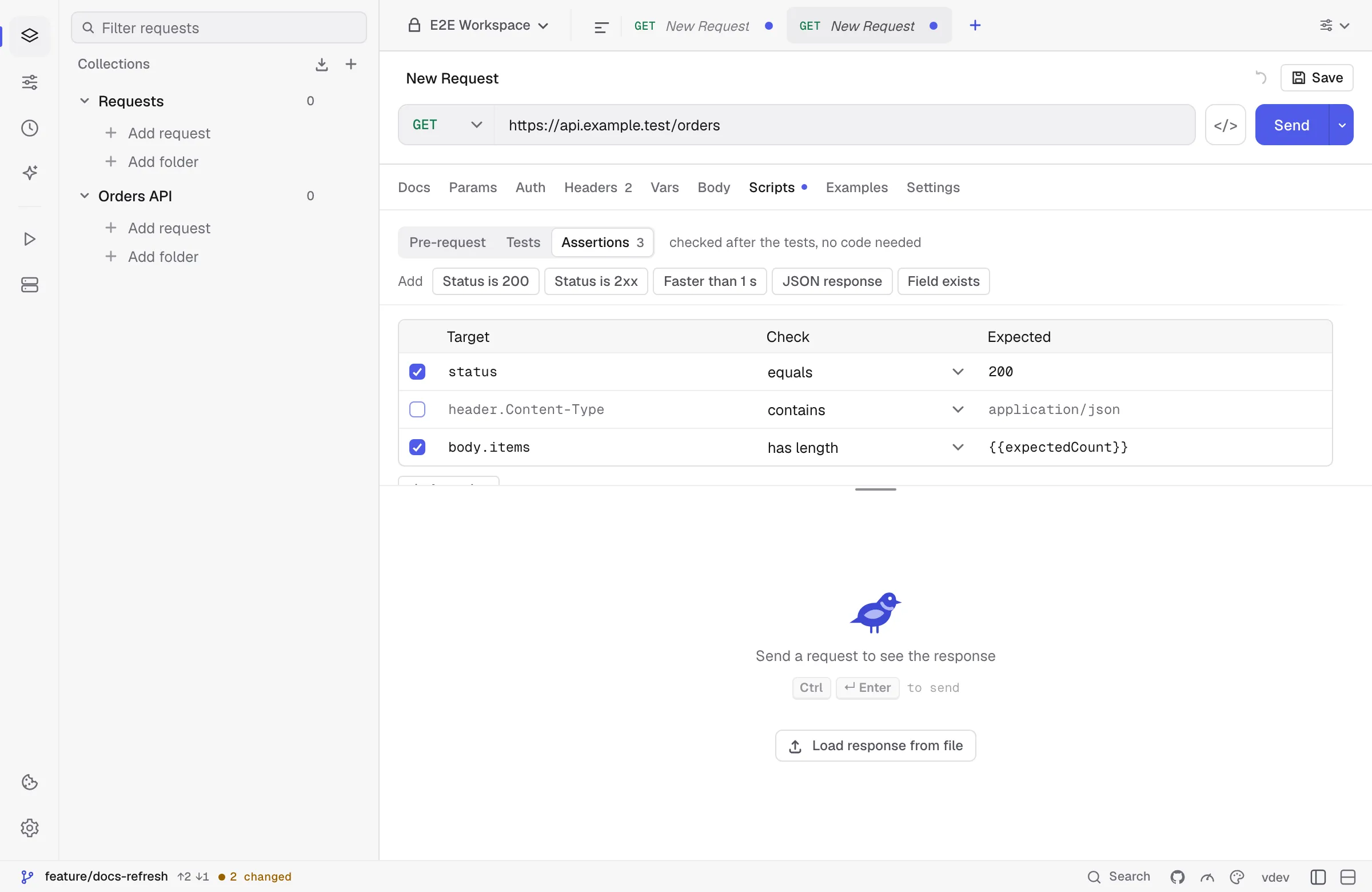
For checks that need no code, open Scripts → Assertions on an HTTP or GraphQL request. Each row is a target, a check and the expected value. The Add row inserts common ones: status 200, a 2xx status, a response faster than one second, a JSON content type and a field that exists.
| Target | What it reads |
|---|---|
status | The status code, such as 201. |
responseTime | Total time in milliseconds. |
size | Body size in bytes. |
header.<Name> | A response header, matched without regard to case. |
body | The whole body: parsed JSON, or the text when the body is not JSON. |
body.<path> or $.<path> | A value inside a JSON body: body.data.id, body.items[0].sku, body.items[-1] for the last item, body["key with spaces"]. Filters and wildcards are not supported; use a test script for those. |
Checks: equals, does not equal, is greater than, is at least, is less than, is at most, is one of and is not one of (a list such as 200, 201 or [200, 201]), contains and does not contain (text, an array item or an object key), matches regex, exists, does not exist, is of type (string, number, boolean, object, array or null) and has length (of text, an array or an object).
The expected value is read as JSON when it is valid JSON, so 201, true, null and {"a": 1} compare as values, and as text otherwise. Numbers compare exactly, including integers larger than JavaScript can hold. Header values are always text. {{variables}} work in both the target and the expected value.
Assertions run after the test script and show up next to its tests, named after the check, such as status equals 201, with the reason when one fails, such as got 404. A failed request fails every assertion. A request skipped with pm.execution.skipRequest() is reported as skipped, and its assertions do not run. The same results count in the collection runner, in kurlo run (and its JUnit report) and in kurlo mcp. Untick a row to keep it without running it. A request can have up to 200 assertions; the add buttons turn off at the limit. A request file written by hand with more keeps all of them, and they all run.
Assertions are saved in the request file as assertions. A Postman export turns them into pm.test code so Postman runs the same checks; importing that export back into Kurlo restores the rows without doubling the tests. Insomnia and OpenCollection exports leave them out.
Snippets
Section titled “Snippets”The Snippets row above the editor inserts working code at the end of the current script — setting a variable, adding a header, editing or signing the body, asserting a status, checking a JSON schema. The list follows the active engine, so Tengo requests get Tengo snippets. Hovering a snippet shows the code it will insert.